
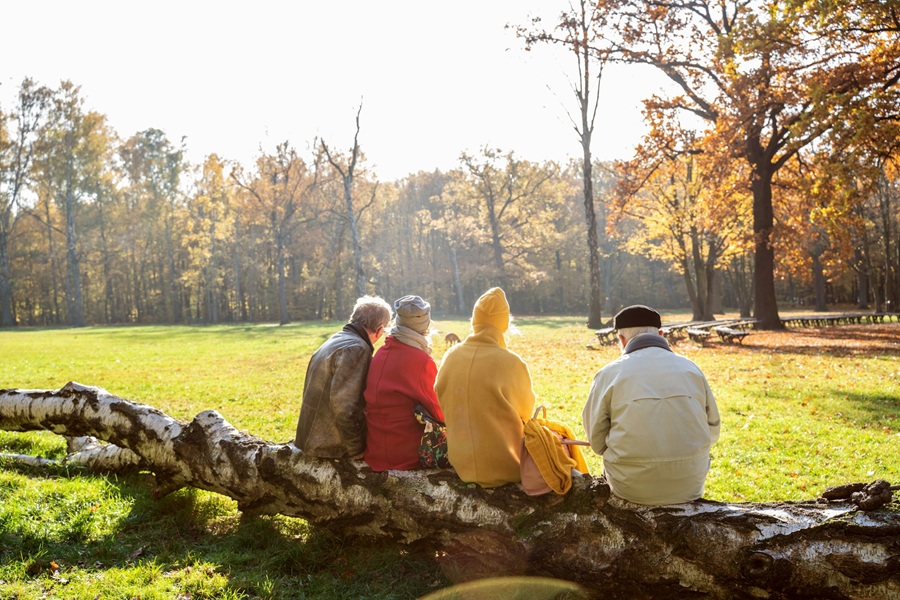
Loneliness is no longer seen solely as a private pain – it’s a growing public health crisis affecting people across ages and continents. Chronic loneliness is linked to higher risks of depression, cardiovascular disease, cognitive decline, and even mortality. Yet, solutions that are both effective and culturally adaptable remain limited.
Our latest open-access article « Adapting and applying a group facilitator training model to support nature-based social interventions for alleviating loneliness in five countries » published in Educational Gerontology, explores exactly that: how the Finnish Circle of Friends (CoF) model – an evidence-based group intervention for alleviating loneliness – was transformed into the Friends in Nature (FiN) program within the RECETAS Project.
Why We Need New Approaches to Loneliness
As urban living increases and social bonds evolve, chronic loneliness has become a complex, multifaceted challenge. Traditional group programs and clinical treatments often fail to take full cultural or environmental contexts into account. What if part of the solution could be found not in a clinic but in a garden, a park, or a forest, under the guidance of trained leaders who understand both people and place?
The RECETAS team explored exactly that, adapting the CoF model to diverse international contexts to tackle loneliness in culturally meaningful ways.
Introducing the Friends in Nature Facilitator Model
The FiN program is based on the Circle of Friends approach but tailored for nature-based social interventions. At the heart of this adaptation is a multi-stage facilitator training model delivered across Spain, France, Czech Republic, Australia, and Ecuador.
The training process included:
- Moving from in-person to online training to increase accessibility and scale
- Training key facilitators who then trained local facilitators in each country
- Implementing FiN groups using structured, nature-based activities to foster social connection
Despite cultural differences, the core elements of the CoF model (group cohesion, supportive facilitation, and shared activity) remained strong and adaptable.
Why It Matters
Loneliness is a global challenge and often stigmatized. FiN uses nature, groupdynamics, and empowerment to help participants build meaningful social ties. By combining evidence-based facilitation techniques with culturally sensitive adaptations, the program creates safe spaces for connection, reflection, and mutual support.
This approach shows that nature-based interventions aren’t just about being outdoors: they’re about empowering people to engage socially in ways that are meaningful to them, regardless of cultural context.
What’s Next
While this publication focuses on the training model, outcome analyses are underway to examine how these adaptations influence effectiveness across diverse populations.
The research RECETAS research teams will provide practical on social prescribing, nature-based interventions, with scalable training models for international implementation.
By equipping facilitators with skills that are both evidence-informed and culturally adapted, the FiN programme represents a scalable pathway to reduce loneliness while fostering social inclusion and well-being worldwide.
Commentaires récents